
Bringing the Science of Simplicity™ to your game...
ARE YOU TIRED OF
MENTALLY AND PHYSICALLY
TWISTING YOURSELF OUT OF SHAPE
TRYING TO HIT A GOLF BALL?


Hi! I'm Ron Sisson, Professional Golf Coach/President of Real Swing Golf and the innovator of the Real Swing Golf Method®, a methodology of golf instruction powered by
The Science of Simplicity™
You are probably wondering, "What is the Science of Simplicity™?" I'll explain this later on but before I do, can you do one thing for me?...
Just admit it... you're hooked!
How do I know you're hooked? I know you're hooked because you wouldn't be reading about my Real Swing Golf Method® of golf instruction if you weren't addicted to trying to figure out this puzzle called golf, would you?
I also know what hooked you... It's thatshot.
You know the one… Sweet, vibration-less impact that feels incredibly powerful, yet strangely effortless... Soaring, majestic ball flight, arcing beautifully towards your intended target.
In some mysterious way, that shot happens from time to time, usually once every couple of blue moons. You're not quite sure what you did to make it happen but you know you desperately want it to happen again. And again. And again. It’s like an addicting drug that you can't get enough of.
You step up to your next shot, anticipating, hoping, praying that it will happen again. You make your swing and… as you watch this shot fly like a bullet 6 inches above the ground, skip 5 times across the lake, hit the bank on the other side and plop back into the lake, you think to yourself, “That swing didn’t feel any different than the last one that I hit perfectly! What the heck did I do wrong?”
As frustrating as your inconsistency is, you soldier on, willing to twist yourself into multiple physical and mental pretzels trying to have that shot happen more that just once or twice a round.
You know what I also know about you and your addiction to that shot?
It has so hooked you that you've been to dozens of other websites, videos, golf instruction books, golf magazines, all with the same desperate quest... (It's almost like I can read minds...)
You're hoping to find... the SECRET!
How's that been working out for you?
Are you having fun yet?
There is a better way...
As you read on, here's what you will come to understand...
Striking powerful, accurate golf shots is both harder and easier than you think. (I know, I know... It sounds like one of those 'oxymorons' but read on and you'll understand why it's true.)
The ideas you have about how to hit a golf ball — no matter where those ideas came from — have always been incorrect and are actually the cause of your problems, not the solution!
By understanding and learning to utilize a natural motor movement skill development process you already innately possess, you can start on a journey of ball striking skill development that will have you hitting great shots with a consistency you wouldn't dare dream was possible... not in years,not in months, not in weeks, but in minutes!!
No, I'm not joking!!! andYes, I said MINUTES...
Read on and you'll discover why I'm absolutely serious!
Hitting the ball solidly and accurately is actually far harder than you could ever imagine... Here's why...
Why is it so hard to hit a golf ball?
If you think about the game of golf, it's a pretty simple concept: Swing a stick, strike a ball, send it a specific distance and direction toward a number of different targets using various kinds of sticks; total up the number of times you hit the ball over the course of the game and the lower the score, the better.
And it's not like other hand-eye coordination sports like tennis where you have to run around, trying to hit a moving ball: The ball just sits there, perfectly still, waiting to be struck. And you have numerous specialized, highly engineered sticks to hit it with...
I mean, how hard can it be?
And yet, you, and most average golfers like you, rarely get that satisfying 'thwack' sound, the auditory indicator of precision contact, often followed by beautiful, on target ball flight.
So why is it so hard to hit a golf ball long and straight?
The Pros on TV sure make it look easy!
Perhaps… But what they are accomplishing — and what is required of you if you want to hit powerful, accurate shots like they do — is quite astonishing!
Here are some amazing facts about what it takes to hit long, straight shots that you probably didn't know...
From its starting position at address to its settling at the swing's conclusion, the clubhead will have travelled some 35 or more feet as it whirls around your torso in a huge, more or less circular orbit.
Relative to the straight target line, the sweet spot of the clubface will have moved in a curving arc, either curving toward the target line on the downswing or away from it after impact, only briefly touching the target line for a millisecond at impact. (Ideas like swinging the clubhead "straight back and straight through" or "keeping the clubhead moving straight along the target line through impact for as long as possible" have always been false and are in fact attempts to defy the laws of physics.)
During the forward swing, as the clubhead moves from waist high on the downswing to waist high on the follow through, the clubface will have gone from facing 90 or more degrees open to the intended target to 90 or more degrees closed after impact in about 600 milleseconds, a touch more than half a second.
Impact with the ball has three phases: Initial impact (the exact nano second when the clubface just barely touches the outer surface of the golf ball), Compression (the ball flattening against the club face due to the force of the impact) and separation (the exact nano second when the ball leaves the club face). These phases of impact occur over a distance of three fifths of an inch – which means that the ball and the club face are in contact with each other, and travelling together, for just more than 1/2 an inch.
For the shot to be directionally accurate, at initial impact the clubface would have to have been fractionally open. Then in the next approximately 1/4 inch, the clubface has to rotate to perfectly square or very close to it at the height of the compression phase of impact – just 1 degree open or closed will send the ball some 20 yards wide of the intended target. Then, as the ball rides along with the clubhead for the final 1/4 inch or so of impact, the club face will begin closing as the impact phase concludes with the ball separating from the club face. (The idea of "keeping the clubface square for as long as possible" has always been false and is in fact yet another attempt to defy the laws of physics.)
How fast is the clubhead moving
while all of the above happens?
Depending on who is swinging the club, it will have reached a peak of speed at impact somewhere between 70 and over 120 miles per hour while accelerating from the top of the back swing down to impact – in the case of Rory McIlory – in just 239/1000th of a second. That's a rate of acceleration 5 timesfaster than a top fuel dragster! (You – yes little old you – will likely be able to accelerate about 3 times faster than a top fuel dragster!)
So just to make sure we're straight:
The clubhead is going to swing around you in a huge circle, in a curving arc, while the face rotates a full 180 degrees, accelerating faster than a top fuel dragster, reaching speeds at impact far faster than you should safely drive your car...
...and just how do you have to impact the ball to hit
the long, straight shots you want?...
Impact:
Want sweet feeling, powerfully struck, long shots? The ball must be struck to within 1/16th of an inch accurate of the the center of the clubface or better – presuming you want those sweet, vibrationless impact shots that make golf fun. (For a “real world” perspective of what a 16th of an inch is, take a nickel, turn it sideways and look at the thin edge of it. That’s a 16th of an inch.) If you do strike the ball off the center of the clubface, you are just 1/4 of an inch away from "sort of okay, that'll do..." shots, 1/2 an inch away from "bad" shots, and a mere 3/4ths of an inch away — about the measurement of your middle finger from edge to edge — from hand-stinging, "terrible" shots.
Face position at impact for relatively straight shots:
Want straights shots with minimal curve? The club face must be within 1/4 to 1/2 a degree of perfectly square at the compression stage of impact. (...All while the clubface moves from waist high to waist high, rotating through a full 180 degrees like a swinging saloon door, about as fast as you can blink your eyes!)
If your clubface is just a mere 1 degree open?... Big fade. 2 degrees open?... Slice. 3 degrees open?... “Deep in the trees” slice. 4 degrees open?... “Over the trees and onto the other fairway” slice…
Are you starting to see why it’s
so hard to hit a golf ball long and straight?
When you really understand what is going on during a successful golf shot—the distance the clubhead travels, the incredible speed and acceleration, the curving path it follows and the rotating clubface—and then you have to hit it how close to center?...AND almost perfectly square at impact as the clubface rotates a full 180 degrees on the forward swing about as fast as you can blink???
Pure Insanity!!!
It's a wonder anyone can do this at all!
After reading the above, if you're starting to feel depressed and wanting to give up the game, all I can say is,
"I don't blame you!"
I completely understand...
But take heart...
There's good news to follow...
Do you remember earlier that I said that you'll be, "...hitting great shots with a consistency you wouldn't dare dream was possible... not in years,not in months, not in weeks, but in minutes!!"?
What did I also say?
I'm not joking!
Here's the proof...
Watch this 'never held a club before' beginner go from this...
...to this in just over an hour!
Think the above before and after was a fluke...? Think again!!! Watch this young lady go from brand new beginner...
...to hitting tour pro quality shots... in one hour!
Watch Jewel, new golfer with 2 days experience,
go from stumbling, off balance topped shots...
...to hitting it dead flush with a "stick the landing," perfectly balanced Tour Pro finish... in just over an hour!
You didn't think Jewel was just a "one off," did you...?
This "second time to the driving range" person
goes from mostly topped shots...
To "far and straight" in... you guessed it... 1 hour!
Maybe you're not a brand new beginner. You're the 'half a dozen times a year' Novice Golfer... Of course I have examples of golfers at your skill level improving dramatically...
This Novice kept missing the ball... or when he did manage to make contact, hitting topped shot grounders...
One hour later...? You guessed it... long, straight shots that just "keep on going..."
This person just could not get the ball airborne...
Then, not only is she hitting all her shots in the air, she's self correcting AND doing 'trick shots'... in one hour!!!
Darcy had the classic "reverse weight shift, dig the clubhead into the ground before hitting the ball" swing...
An hour later, things are "Much better!"
(And the reverse weight shift is gone!)
This hockey player was dragged to this lesson
by his soon to be father-in-law...
(This novice was marrying into a golfing family.)
An hour later, after he hits about a dozen solidly struck, dead on target shots, I ask him this question...
This novice got dragged to this lesson by his avid golfing wife... He was not too pleased to be there at first...
In about an hour's time, his mood changed dramatically after he hit this shot on his very first attempt
with his new 'real' swing...
Perhaps you're an average to above average golfer... You won't believe what the Real Swing Golf Method® can do for you! Watch what it did for these more experienced golfers...
Brad's contact was inconsistent and he just wasn't getting any distance on his shots...
An hour later and he is literally shocked by the results...
Dylan struggled to get the ball airborne and generally lacked consistency due to his overly slow back swing
and his sudden, lurching forward swing...
One hour later, he's flushing it like a tour pro with a smooth, flowing, powerful 'real' swing...
Is your swing like his before swing... Hesistant, careful, 'controlled,' lacking any speed or power?
After learning the concepts and principles of Real Swing Golf, you can see and hear the power of his new swing...
(Yes, he's wearing the same clothes
so you know it took about an hour)
This fellow's swing was like most golfers who are told to 'slow your swing down'...
An hour later, he's showing off and purposely positioning the ball 'too far away' and still hitting great shots!
His swing was pretty good to begin with but he had a consistent problem with a slice...
He straightened things out fairly quickly and then went on to prepping to audition for the 'Happy Gilmore' sequel...
His swing was also pretty good but just a bit too much tension and a persistent problem with a slice...
An hour later the slice is under control, contact is consistent and he's getting pretty good at the trick shots...
After watching all of these amazing before and after 1 Hour Swing Makeovers, I'll bet you're wondering, "How the heck did you get that much improvement from your students in just 60 minutes?" Well the truth is...
Hitting the ball solidly and accurately is actually FAR EASIER than you could ever imagine...
Now I know you're probably thinking, "Wait a minute! Earlier, you said that it was far harder than I can imagine... Now you're saying that it's far easier?!? Make it make sense!"
To be fair, I said, and I quote: "Striking powerful, accurate golf shots is both harder and easier than you think." Truly, an oxymoron of the highest order. So let me explain...
After learning about all the requirements for hitting long, straight shots that you didn't know about before — the huge circle, the clubhead moving in an arc, the rotating clubface, the precision required for solid contact and squareness of the clubface, the incredible speed this all happens at, etc... — you might be tempted to thinkthat it would take years to be able to get even remotely close to being able to hit long, straight shots.
And yet my students — even brand new beginners who had never touched a club before — were able to hit powerful, accurate shots in 1 hour!!!
Well, to be truthful they didn't take the full 60 minutes of lesson time to get to that point.... It took 10 minutes of some simple swinging drills without the ball to get the feel of the "real" swing and then 10 minutes of using their new real swing to hit balls in just the last 20 minutes of the lesson!!!
What I helped them learn in the first 40 minutes of the lesson created the understanding that was necessary before such amazing improvement could become possible. After learning about the astonishing requirements for long, straight shots that we outlined above, they also learned the following:
Life is a never ending experience of hand-eye coordination movement tasks, all day, every day. You use the distance and depth perception information from your eyes to use your body — mostly your hands — to accomplish all kinds of movement tasks: Walking, running, reaching for objects like food items at the grocery store, manouvering your mouse on your computer, touching menu choices on your smart phone or tablet, eating, drinking, reaching for your towel when you get out the shower... your entire day is hand-eye coordination movement tasks.
Striking a golf ball is just one of these many hand-eye coordination movements and is now and has always been a relatively simple action of specialized hand-eye coordination skill that involves swinging an implement and striking a stationary object and sending said object a certain distance and direction toward an intended target.
In the plainest possible language, Golf requires you to swing a stick and strike a motionless ball with the clubhead end of the stick. Accomplishing this simple task requires the development and consistent execution of what I call the Critical Clubhead Skills™
Skill #1 — The Swinging Skill: "Swing Clubhead Freely, Fluidly, & Fast (through impact)" The three "F's" are the defining characteristics of an actual, real golf swing. If one or more of these characteristics are missing, then what you are doing cannot be called a golf swing. "It don't mean a thing if it ain't got that swing!"
Skill #2 — The Striking Skill: "Strike Ball With Swinging Clubhead"**
Well duh!... This one is so patently obvious that the idea of even having to mention it seems absurd. However... as you learned from the information presented above, there is a double asterisk of "fine print"... Yes, you do have to strike to within 1/16th of an inch accurate to the center of the clubface — Asterisk #1 — with the clubface being no more than one half of a single degree from perfectly square at the height of compression stage of impact — Asterisk #2 — all while the clubhead whirls around you in a huge circular path at blazing speed in a curving arc with 180 degrees of clubface rotation that happens about as fast as you can blink... But that's only if you want those powerful, accurate shots that hooked you on golf in the first place.
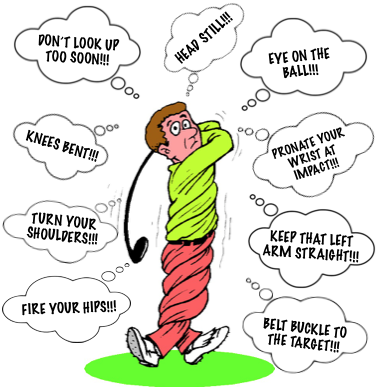
After helping my students to see the action of striking a golf ball as a relatively simple act of hand-eye coordination skill, I had to help them understand that all the advice that they had so far received and/or thought of in their own minds was distracting them from the hand-eye coordination task at hand*: "Keep your head still... Keep your arm straight... Turn your shoulders on the backswing... Turn your hips to start the down swing..." Did you notice that all of these 'swing tips' are body focused? Not one of these ideas is focused on the actual task: Swing clubhead. Strike ball with swinging clubhead. Send ball towards target. (*A more detailed discussion of what these distractions are follows below.)
With some incredibly simple swing execution thoughts and some simple swinging drills without the ball, I helped my students develop Critical Clubhead Skill™ #1: a real swing — a swing in which the clubhead swings freely, with no restricting tension, fluidly, with a rhythmic to and fro swinging motion backwards and forwards, and fast, accelerating with a rollercoaster like momentum during the forward swing, building to a peak of speed at impact — in about 5 to 10 minutes. (Yes you can develop a "real swing" ... not in weeks, months, or years, but in minutes!)
Once they had developed a real swing (Critical Clubhead Skill™ #1), I had them continue to swing without the ball present so that they could focus exclusively on the feel of their new swing. I instructed them to completely ignore their body parts and any advice they had received regarding what to do or what not to do with their various body parts so that they could focus exclusively on feeling the weight of the clubhead carving its orbit around them, especially as it picked up speed and weight through the hitting area.
Next, I added the ball into the picture with the instruction to focus only on the task of feeling the weight of the clubhead swinging around them and to pass its path as accurately as possible through the ball sitting on the ground. They were to trust that the brain's natural hand-eye coordination ability would coordinate whatever body movements were necessary to accurately strike the ball, without any conscious awareness of these movements on their part. The result? I refer you to the incredible swing transformation videos above!
Thats it! The formula is this simple:
See the action of striking a golf ball as a hand-eye coordination movement task. Develop and execute the Critical Clubhead Skills™ necessary to accomplish the task. While executing the task, ignore the tempation to consciously direct your body with 'swing thoughts' — "Keep your head still... left arm straight... shift your weight..." — and trust your mind-body hand-eye coordination ability to self organize the details of your body's moments without your conscious awareness or direction. Focus exclusively on feeling the clubhead's path as it swings around you and try to pass it accurately through the ball... Done!
If you think about it, all these unbelievably simple concepts are straight forward, perhaps one might even say, completely common sense ideas.
I know what you're thinking… "If it's as easy as all that, how come I can't do it? This 'hitting a golf ball' thing has been really hard for me to learn!"
To answer your question, let me ask you a question… What is 2+2? Obviously, the answer is four, and no, I'm not trying to insult your intelligence. There was a certain period of your life when you didn't know the answer to that question. (You also didn't know how to walk, talk, or read during that same period.) Eventually, with proper education and coaching, you were able to correctly answer the 2+2 question.
Now what would happen if you were taught that 2+2 equals 22? And 4+9 equals 49? And 9+4 equals 94? How would you do in the real world of mathematics if you were given an incorrect idea about the foundational rules of mathematics?
Similarly, if throughout your entire golfing life, you have been focusing exclusively on how to move your body 'correctly' hoping that that would somehow make the club move correctly to hit the good shots you want, you have been robbing yourself of the development of your natural human hand-eye coordination based golfing ability.
How's that been working so far?
In order to put these common sense ideas into practice, you must first understand and then embrace these ideas that are very likely radically different than the ideas you currently have. When you do, you will turn what is currently your greatest hindrance to developing your Critical Clubhead Skills™ into your most potent ally...
Your brain.
Why is your brain so important?
Because everything originates in your brain: Your body will not and cannot do anything until it receives movement signals from your brain. And, most importantly, your body can only obey the instructions it receives. It does not know or care if the instructions given are correct or incorrect: It simply carries them out.
This fact is both good news and bad news.
The good news is that when your brain has correctideas about how to implement and execute the Critical Clubhead Skills,™ your body will carry them out, as you just saw watching the seemingly miraculous 1 hour swing transformations above. Once you understand the unbelievably simple concepts that my students employed to effect their 1 hour swing transformations, you will understand why I can make this claim: Hitting the ball solidly and accurately is actually FAR EASIER than you could ever imagine...
On the flip side, the bad news is that when your brain is filled with incorrect ideas about how to swing a golf club and strike a golf ball..., your body will carry them out... with all the ensuing not so great results!
I am virtually 100% certain that the ideas you currently have about hitting a golf ball are incorrect and, since your body will obey those incorrect ideas, they are the cause of all your bad shots!
Here's why your current understanding about how to hit long, straight shots is actually the cause of your problems...
So in order to get you to where you want to be — hitting powerful and accurate shots consistently — you need to know that in golf, there are Five 'Mental Misperceptions' that you need to understand and then overcome so that you can embark on the development of your Critical Clubhead Skills™ without their interference.
And here's the scariest part of all: Four of these Five Mental Misperceptions are instinctive. You'll likely do all or at least some of these things wrong without even knowing it!
You may be under the influence of one or more of these instinctive misperceptions that might be interfering with your Critical Clubhead Skill™ development:
The Hit Instinct: This happens when golfers make a slow, deliberate back swing and then suddenly and savagely hack at the ball like they are fending off a wild animal with a machete. Skill # 1 — Freely, Fluidly, Fast — goes out the window. All the tension kills the 'freely,' there is absolutely nothing 'fluid' about this motion, and although it looks like there is a burst of speed, the 'fast' is destroyed because tense muscles slow down the swing, not speed it up. That's 0 for 3... If you don't have Skill #1, Skill # 2 — solid contact and a square clubface — ain't happening.
The Control Instinct: Almost the opposite of the Hit Instinct, the Control Instinct happens when golfers make a slow, deliberate swing both backwards and forwards. Ironically, this attempt to "control" the swing creates exactly the opposite result. Do you remember when you were a little kid on a beach swinging a small sand pail full of water in a ferris-wheel-like vertical circle? The speed you created kept the pail following its orbit and the water from falling out of the pail. Now imagine 'slowing your swing down' — like golfers are constantly admonished. Would that give you greater control of the sand pail or an unwanted shower? Real control — either with the sand pail or the clubhead — comes from creating more speed, not less. (I know, I know... it's the exact opposite of what you've been told all your golfing life. But... is slow, careful swinging — which only creates the illusion that you are 'in control' — working for you? Didn't think so.)
The Steering Instinct: This cousin of the Control Instinct is an attempt to control the path of the clubhead, to swing it in a straight line relative to the straight target line and/or to manipulate the clubface in an attempt to keep it squarely facing at the target for an extended period through the impact area. As I've shown earlier, these two attempts at controlling the direction of the shot, either singly or done together, are attempts to defy the Laws of Physics. Defying the Laws of Physics is of course impossible soooo.... Good luck with that!
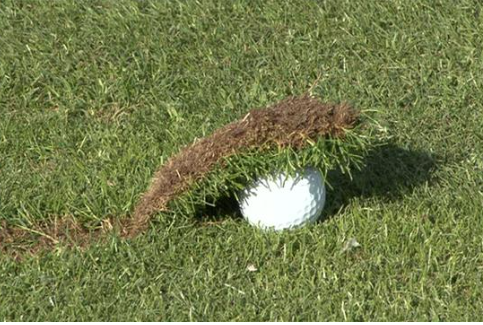
The Lift Instinct: Because the ball is sitting on the ground and golf shots need to get in the air, golfers instintively feel the need to 'lift' the ball off the ground. Golfers will often express this instinctive desire to get the ball airborne with conscious phrases like, "I need to get under the ball." or "I need to swing underneath it." This sentiment implies that the golfer must strike upwards into the ball's under side to make the ball go in the air. Nothing could be further from the truth as this instinctive sense of how to get the ball airborne will lead to nothing but fat, sculled, topped, and missed shots. Why? There's just one tiny little problem with trying to strike upwards at the ball's underside... It's called planet Earth. Please explain how you are going strike upwards at the ball's underside with an entire planet in the way of that? This is the usual result:
After reading about these Four Instinctive Mental Misperceptions, are there any that are ringing a bell with you? Some people only have one, some have two or three, and some can suffer from all four of these instinctive mental misperceptions at various times.
You might be thinking, "How do I know if I am a victim of one or more of these mental misperceptions? And, more importantly, how do I overcome them?"
Well funny you should ask! I am available for In Person Lessons in the Calgary and Live Online Lessons if you can't come and see me in person. I would be able to assess your instinctive misperception issues in minutes and help you get on the right track within a few more minutes... remember the 1 hour swing transformations that you watched earlier? So don't wait any longer! Sign up for In Person or Online Lessons by clicking the appropriate button below...
Seriously though, because I don't know you or what your swing is like, I can't help you without seeing your swing and talking with you directly to suss out which and how many of these mental misperceptions might be vexing you. In just one online session, we can get you past whichever mental misperception(s) that might be plaguing your swing. So send me an email and let's help you get past these mental misperceptions so you can get started on developing your Critical Clubhead Skills.™
The Most Dangerous Mental Misperception:
Mechancial Golfer Syndrome
As dangerous and debilitating as the Four Instinctive Mental Misperceptions are, this last Mental Misperception is a product of the conscious mind and is therefore the most dangerous one of all...
Why?
Because you, your golfing friends, and 99.999% of the men and women who teach golf professionally have a conscious perception about how human beings strike golf balls that has never been true or correct. And your body is carrying out those incorrect ideas perfectly, thereby creating all the bad shots you experience! So ironically, what you think is the solution to your problems... is actually causing them!
A bold claim indeed... but read on and let's see if I can convince you.
What is Mechanical Golfer Syndrome?
Mechanical golfer syndrome is a condition that aflicts the vast majority of golfers around the world. The underlying cause of this syndrome is the belief held by those afflicted by it that the action of striking a golf ball is not a relatively simple action of hand-eye coordination skill but rather a complex exercise of precise positioning and exacting bio-mechanical body movement.
Unlike other hand-eye coordination sports — tennis, baseball, racquetball, ping pong, badminton, etc. — in golf, the object to be struck is stationary. This fact — the stationary ball — led to the development of the following seemingly logical and widely accepted paradigm that consists of a series of underlying theories and assumptions that exist in the minds of virtually all golfers, especially those who teach golf professionally.
This paradigm could be outlined as follows:
"The bio-mechanical movements and positions of the body during the act of striking a golf ball cause the movements of the club. The movements and positions of the bodies of elite golfers (touring and club professionals and high level amateurs) are so similar as to be almost identical and universal – i.e. the bio-mechanically correct swing. Therefore, their skill of consistently striking powerful and accurate golf shots is a result of their ability to move their bodies through these series of correct positions and movements with a high degree of accuracy and repeatability. Hence, for beginning and average golfers to strike powerful and accurate golf shots like elite golfers do, they must make sure that their pre-swing fundamentals – grip, posture, ball position, etc. – and in-swing "fundamentals" – too many rules regarding the "correct" in-swing bio-mechanics to list here without writing a very large book – resemble, as closely as possible, those of elite golfers. Poorly struck and/or misdirected shots are the result of bio-mechanical flaws or mistakes in pre-swing and/or in-swing mechanics. And, unless they spend countless hours retraining their bodies and "muscle memory" to set up and swing in a "bio-mechanically correct" fashion like elite golfers do, beginning and average golfers are doomed to golfing mediocrity."
The essence of this paradigm is that the human golfer can and should aspire to become a sort of "biological golfing machine" — in short, a Mechanical Golfer.
This paradigm – that the body moves the club and 'correct' body movements and positions will create "good" shots and 'incorrect' body movements and positions will cause "bad" shots – is so pervasive, so universally accepted as being true, that no one ever questions it. And virtually all of the allegedly helpful "folklore widsdom" golf tips that you hear from your golfing buddies — "keep your head still, your target side arm straight, and keep your knees bent" — and the endless body focused complexities of modern golf instruction, are based on this way of thinking.
On its surface, the paradigm seems to make good "common sense." But is this paradigm actually true? Is it in reality scientifically valid? Is this really how highly skilled golfers actually develop their ability to consistently hit powerful and accurate shots?
Are you ready for a paradigm shift?
“The earth is a flat disc that sits motionless in space and the entire universe — the sun, the moon, and the stars — orbits around our stationary planet every 24 hours.”
Unless there's an earthquake happening where you are, isn't the ground you're standing on perfectly still? Are you not seeing the sun "move across the sky" from east to west? Don't the oceans and the plains in the middle of North America look really flat? Based on what we can see, the earth is flat, perfectly motionless and fixed in one spot in space, and the rest of the universe is orbiting around our stationary planet every 24 hours... Not only is it scientifically true, it makes perfect common sense, right?... Your eyes aren't lying to you... all you have to do is just look at the observable evidence to know with absolute certainty that it's true!
If you were living before the 16th Century, this paradigm of the workings of the universe would have made perfect sense to you. Then along came the renaissance and folks like Copernicus and Galileo; and with their greater scientific understanding, we now know that what we thought was true about the nature of the universe wasn't actually true after all.
Similarly, this Mechanical Golfer paradigm seems to make sense and it's based on three specific ideas:
1) There is a perfect, ‘correct’ way for your body parts to move while you swing: i.e., the Bio-mechancially 'Correct' Swing.
The clubhead swings as a result of a series of complex, bio-mechanical movements and positions during the swing. Pros like Tiger Woods and Adam Scott do all of these movements and positions "correctly." When you swing, your body moves differently than Tiger Woods’ body does while he swings. That's why he hits good shots consistently and you hit bad shots consistently. You need to spend countless thousands of hours — and countless thousands of dollars in golf lessons, golf instruction videos, golf clubs, golf 'training aids' — to retrain your body's movements so that when you swing, your body moves and looks just like Tiger. Then and only then will you be able to hits good shots consistently.
2) Any time you hit a bad shot, there is always one or more body parts to blame.
“You lifted your head!” Well that makes sense doesn't it? Since you're just a biological golfing machine, if the machine is properly positioned to the ball and all of the parts of the machine move 'correctly' during the swing, this automatically means that the clubhead will swing freely, fluidly, and fast around you and strike the ball in the middle of the clubface with incredible precision and with a perfectly square clubface at impact and a long, straight shot will be the result! Therefore, if the ball is mishit and/or misdirected, some part or parts of you, the biological golfing machine, must have "broken down." Now you need to hunt down which one or more of your multitudinous body parts committed the offense and get them to behave properly on your next swing!
3) Practice the bio-mechanically ‘correct’ swing enough times and it will eventually happen automatically by ‘muscle memory.’
It's obviously true that 1) there is a bio-mechanically correct swing, and it's also true that 2) improper body movements cause all your bad shots. Therefore, you must spend countless thousands of hours doing 'muscle memory' drills to burn the bio-mechancially correct swing into your muscles. It is the only path to ball striking Nirvana where your muscle memory is so deeply 'burned in,' your swing operates automatically so that those pesky bad shots will never ever happen again!
On the surface, all three of these ideas seem to make perfect sense.
But what if each one of these three pillars of the Mechancial Golfer paradigm are not true?
What if they only seem to make sense on the surface but in reality — like the idea that the earth is the stationary center of the universe — they have NEVER been true?
And consider this: What if... not only are they NOT TRUE, they are, in reality, the ROOT CAUSE of all your ball striking woes?
So let's take a look at each of these three pillars of this Mechancial Golfer paradigm — which I often refer to as the Traditional Instruction Paradigm (TIP for short) — to see if they can stand up to logical and scientific scrutiny...
TIP Premise # 1: The bio-mechanical movements and positions of the best ball strikers most closely resemble the bio-mechanically 'perfect' swing. Average golfers should try to copy their positions and movements to become more consistent.
PGA and LPGA Tour Pros who are said to possess “bio-mechanically correct” swings are often used in swing analysis computer programs where average golfers’ swings are compared in side by side split screen with these players. They are then shown which parts of their swings don’t match the model and are encouraged to do countless hours of drills to make their body’s movements and positions conform more closely to the “correct” swing.
The logic goes something like this:
Tiger Woods hits good shots consistently because he has a “bio-mechanically correct” swing.
Players who have one or more technique "flaws" in their swings won't be as consistent and won't be able to compete at a high level.
Therefore, "fixing" swing flaws is important for every level of golfer, especially average golfers because everybody knows that the body moves the club and 'correct' body movements and positions will create "good" shots and 'incorrect' body movements and positions will cause "bad" shots. And, because average recreational golfers typically have more 'swing flaws' than elite level golfers, their only chance of playing half way decent recreational golf is to fix their swing flaws so that their body movements and positions while they swing look more like the 'biomechanically correct' model.
If this logic were true, then you would find that, with almost no exceptions, players at the pinnacle of Professional Golf would have biomechanically 'correct' swings. A player having a flawed swing wouldn't have the consistency to play at the highest levels of the game, right?
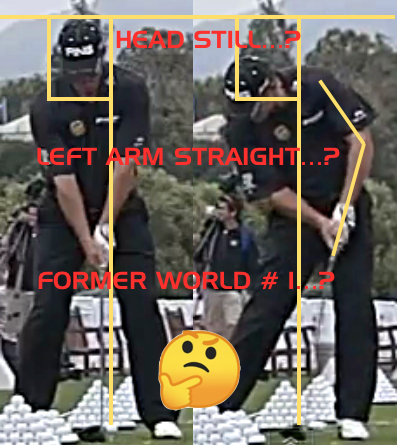
Then how do you explain Lee Westwood who took over the World #1 ranking from Tiger Woods in the early 2010's? How did Lee become World #1 with a swing where his head moves 8 inches downward and 3 inches backwards, along with a 40 degree bend in his left arm at impact?
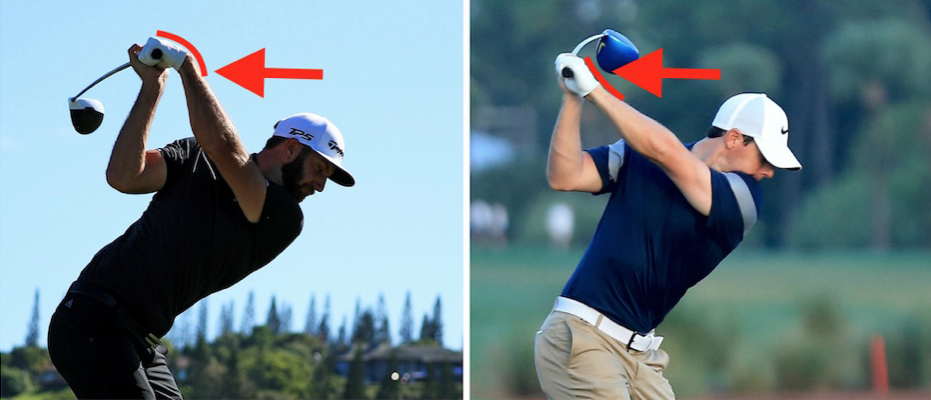
Maybe Masters winner, US Open Champion and former World #1 Dustin Johnson (left) should ‘fix’ his extremely bowed left wrist — allegedly a 'major swing flaw' — so it matches 4 time Major Champion and former World #1 Rory McIlroy’s ‘correct’ slightly cupped wrist position…
Maybe Players Champion and two time PGA Champion and former World #1 Justin Thomas should ‘fix’ his obviously flawed foot work…
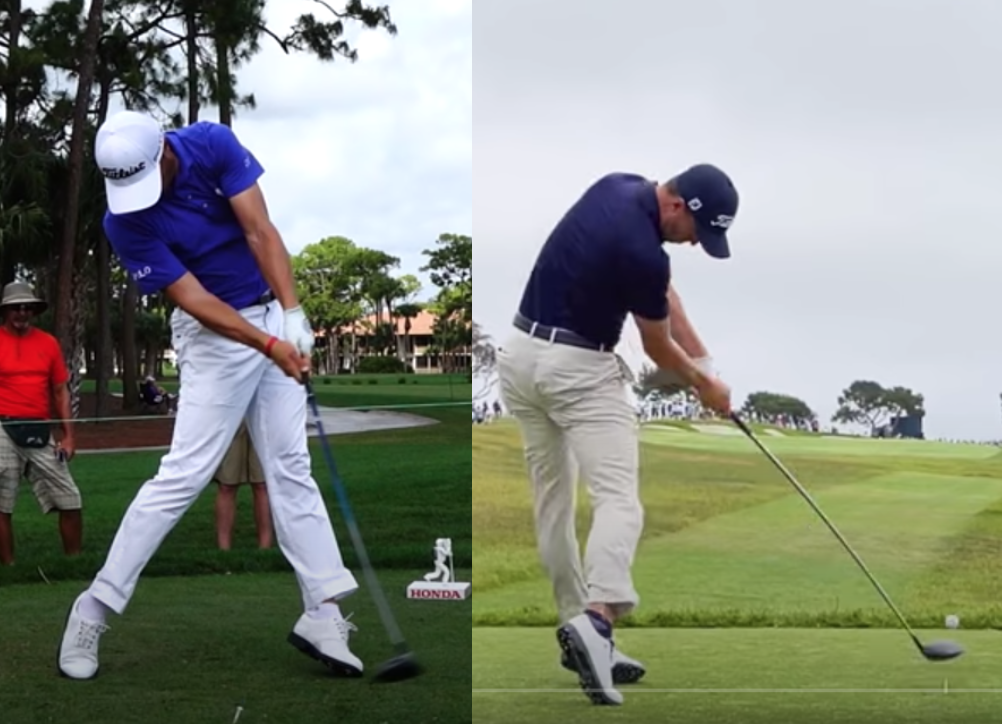
Currently (2023), there are three Top Players in men's professional golf who have been playing "Hot Potato" with the World # 1 ranking: Scottie Sheffler, Jon Rahm, and Rory McIlroy. Only one of these three players — Rory McIlroy — is purported to have a 'biomechanically correct' swing... Take a look at current (November 2023) World # 1 Scottie Scheffler's very 'interesting' footwork...
And then there's former World # 1 Jon Rahm... Unlike former World # 1 Rory McIlroy whose back swing is in a 'correct' top of the backswing position (club shaft parallel to the ground and pointing parallel to the target line), Jon Rahm has a back swing that is 'too short,' and 'off plane' (the shaft of the club points way left of, instead of parallel to the target line), and, like former World # 1 Dustin Johnson, he 'incorrectly' bows his left wrist...
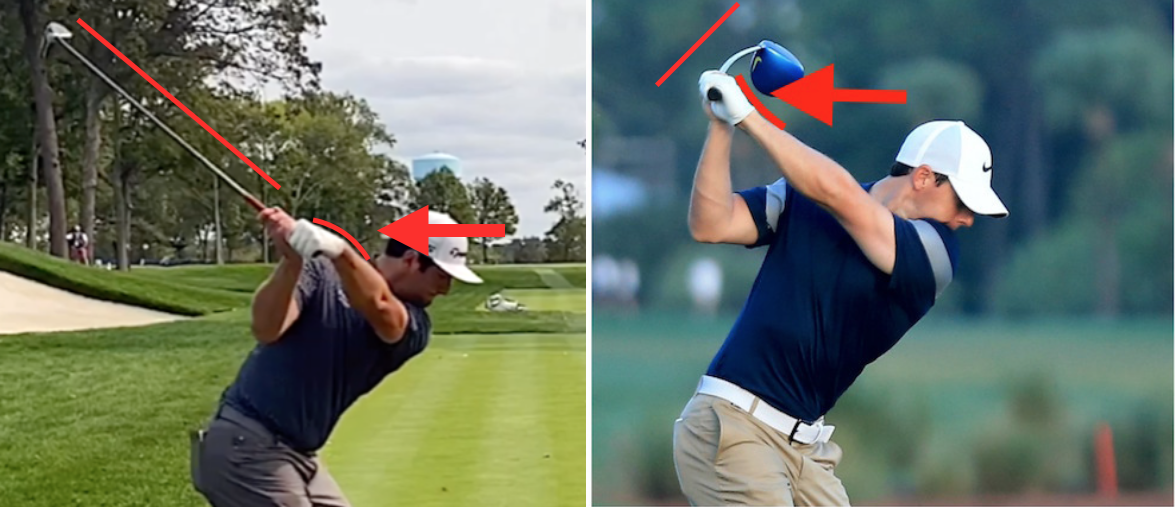
From the face on view, Rory McIlroy (right) has a 'correct' impact position with the clubshaft lining up with his target side arm. Jon Rahm's impact position looks like something might break!
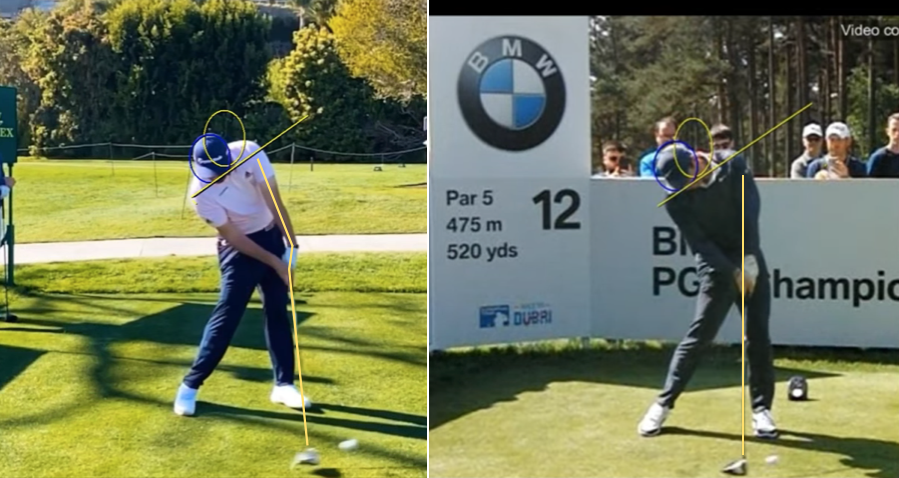
I know what you're thinking... "OK Ron, you've made your point. You don't have to have a 'biomechanically correct' swing to play golf at the highest levels. But you must admit that to shoot record low scores — like low 60's or even breaking the 60 barrier and shooting scores in the high 50's — a golfer would have to have a close to perfect swing like Tiger, yes?"
Over a span of almost 50 years since Al Geiberger first broke the 60 barrier with a score of 59 in 1977, scores in the 50's on the PGA Tour — arguably the highest level of competition in professional golf — have only been recorded 12 times in all that time: Such is the rarity of achieving a score below 60.
You would think that Tiger Woods' name would be on the list of players who have accomplished this feat but alas, the man with the 'perfect swing' has not been able to do it. (He has several 61's to his credit though.)
They of the 'flawed' footwook — former World #1 Justin Thomas and current World #1 Scottie Scheffler — have both gotten their names on the list, having scored a 59 in 2017 and 2020 respectively.
Would you believe that only 11 men have recorded these 12 sub-60 scores? This of course means that one man has two scores in the 50's to his credit!
I know what you're thinking... "Ron, surely you jest! But if it is true, to accomplish this super human feat surely this person must have the most 'biomechanically sound' swing of all time!"
Jim Furyk is the man who has two scores in the 50's: He scored a 59 in 2013 and in 2016, he had a putt on the last hole for a 57 that just missed, leaving him a tap in for a 58, a PGA Tour record low score. At that time, it was only the 7th time that a sub-60 round had been recorded on the PGA Tour.
I'll let you judge the 'biomechanical soundness' of Jim "Mr. 58" Furyk's swing...
You thinks Jim Furyk's swing is weird?... Oh we're just getting started!
Now keep in mind all of the following swings that you are going to see are all golfers are currently making or, in the past, have made their living playing professional golf!
Let's start with Eamon Darcy. The Irish golfer finished in the top 30 of the European Tour's Order of Merit (the top money winners) 8 times during the 80's and tallied 4 wins. He also played a large part in the 1987 Ryder Cup, defeating Ben Crenshaw in the Sunday Singles competition, securing an important point that helped the European Team win their second straight Ryder Cup for the first time in the competition's history.
Next up we have Korean golfer Ho Sung Choi. His swing is very much his own. (For a more indepth look at Ho Sung Choi's story, click here: https://www.youtube.com/watch?v=TQHruSYqPFI )
Now let's look at Allen Doyle. After an elite amateur career, he didn't decide to play professionally until the age of 46. His career included 23 wins as an amateur and 19 professional wins, including two US Senior Open Championships. (For more on Allen Doyle's story, click here: https://www.youtube.com/watch?v=odvvT2eGb_g )
Carl Yuan's swing and practice methods are unique to say the least. The Chinese golfer represented his nation at the 2020 Olympic Games...
How about Matthew Wolff? After a stellar career as an amateur he turned professional in June of 2019 and started out playing on sponsor's exemptions. By July, he had earned his PGA TOUR card by winning the inaugural 3M Open in just his 4th start at age 20. See if you can detect anything unusual about his swing...
I think that Matthew Wolff somehow got possessed (in a good way) by the spirit of the late Jimmy Bruen...
While we are on the subject of golfers named Jim, how about the swing of Jim Thorpe...
Speaking of weird how about Josh Broadaway's cross handed grip?...
You think Josh Broadaway is just a one off? Patrick Welch won the inaugural Augusta National Drive, Chip, and Putt competition in 2014 in the boys 14-15 age division hitting every shot cross handed. He's now a competitive college player and working towards playing on the PGA Tour...
As you can see, there is no exact correct way to swing. Here are a couple compilation videos of unique swings from around the world...
So what should you take away from what you have just seen?
TIP Premise # 1 – the idea that you need to have a 'biomechanically correct' swing – is now and always has been false...
For any scientific theory and the paradigms that form around it to be valid from a scientific viewpoint, the observable evidence must consistently support the theory with very few anomalies or contradictory evidence. There is more than enough evidence that contradicts the theory: There are way too many golfers – often legendary golfers – whose swings are exceptions to the 'bio-mechanically sound' alleged 'rule.' In fact, most professional golfers will have at least one aspect of their swing that could be seen as a mechancial 'flaw.' This means that having a perfect, 'biomechanically sound' swing is the exception, not the rule!
Therefore, TIP Premise #1 – the 'necessity' of copying the 'correct' bio-mechanical positions and movements of those few tour pros whose swings are the most technically sound so as to achieve consistent ball striking skill – while it seems to make sense on paper, it is, in reality, a false premise. So it turns out that TIP Premise #1 is not the correct explanation for the remarkable ball striking skill of elite golfers, nor is it the path for average golfers to take in their quest to improve their ball striking skill.
There is no 'right' way that your body has to move when you swing. Based on a myriad of factors – how your body is built, your flexibility, your level of athletic coordination, any physical limitations that you might have and a host of other factors – the way that your body will move during your swing will be unique to you.
If the way your body moves when you swing doesn't fit the 'biomechanically correct' mould, should you try to 'fix' it? What if you have a particular physical characteristic that limits what you can do?
Let see what former World #1 Jon Rahm has to say about it...
So the mechanics of Jon's swing developed out of necessity to accommodate the physical limitations of his right leg and the hyper mobility in his wrists. And because his swing didn't 'look right,' he had golf coaches throughout his life try to change him. Fortunately, Jon had the strength of conviction to do it his way. He says...
"Don’t try to be perfect. I’ve had multiple teachers through out my life tell me I need to get [my back swing] to parallel in a perfect position and I’ve basically said “No” since I was 14 to all of them…
You know who the best teacher is? The golf ball. Is the golf ball going where you want? “Yeah.” Then there’s nothing to change."
Jon said "No" to those who were telling him that he needed to change from the swing that he developed with the help of his coach, that was working well for him personally, that adapted well to the physical limitations that he had... just because it didn't look like some mythical "perfect" swing.
Jon said "No" to the idea of the 'biomechancially correct' swing and so should you!
So what should you do? Take the advice of the legendary Arnold Palmer...
"Swing your swing. Not some idea of a swing. Not a swing you saw on TV. Not that swing you wish you had. No... Swing your swing. Capable of greatness. Prized only by you. Perfect in its imperfection. Swing your swing. I know… I did."
– Arnold Palmer
I know what you're thinking... "How do I know if my alleged 'swing flaws' are are in fact "perfect in their imperfection?" What if they are in reality affecting the development of these Critical Clubhead Skills™ that you advocate?"
Well funny you should ask that very pertinent question!
There are in fact times when I do help an individual golfer with a particular swing flaw. The bowed left wrist for example: I would never try to 'fix' the bowed left wrist of a Jon Rahm or a Dustin Johnson. But for many new golfers, their left wrist bows as a result of the steering instinct as the try to keep the clubface 'square' on their backswing instead of letting the face naturally open. Sometimes it is necessary to fix it... and sometimes it's not... It depends on the individual golfer.
I know what you're thinking... "I'm not a golf coach! How in the world am I supposed to know if I should fix a particular flaw that I might have or just leave it alone?"
Well funny you should ask!
I guess your best bet is to let me use my almost 40 years of full time teaching experience to help guide you through the process of understanding and developing your Critical Clubhead Skills™ and we'll assess together if any of your perfect imperfections need 'fixing' or not.
I am available for In Person Lessons in Calgary and Live Online Lessons if you can't come and see me in person.Now that you know that I'm not going to force you to rework your entire swing to look like somebody else, what are you waiting for? Sign up for In Person Lessons or Online Lessons by clicking the appropriate button below...
So in summary, what should you take away with regard to the idea that you need to have a 'biomechanically correct' swing to hit good golf shots consistently?
In reality, there are actually very few golfers who have 'biomechanically correct' swings and, as you've seen demonstrated above, you can play golf at the highest levels without one! So no, you don't need a 'biomechanically correct' swing.
The way that your body moves when you swing naturally will be unique to you and will be based on numerous factors. Swing your swing!
You would only need to correct a swing flaw if it is affecting your ability to develop and/or execute the two Critical Clubhead Skills™.
Rather than waste your time and energy chasing the mythical idea that you can contort your body into some conception of a 'biomechanically ideal swing,' you could first learn the real reason that all of the above Professional Golfers – despite the wild variability in their swings – have the ball striking consistency that they possess: They all have highly developed Critical Clubhead Skills™. Then, armed with that knowledge, you can focus your time and energy developing and mastering your Critical Clubhead Skills™.
So now let's take a look at the second pillar of this Mechancial Golfer paradigm — Traditional Instruction Paradigm Premise #2 (TIP for short) — to see if it can stand up to logical and scientific scrutiny...
TIP Premise # 2: When any golfer – whether they have correct swing bio-mechanics or not – strikes an uncharacteristically bad shot, there must have been a change in their bio-mechanical movements that caused it: For example, 'Her weight stayed on her back foot during the forward swing causing her to hit the ground behind the ball.
This premise logically flows from the first premise: Since “the body moves the club and 'correct' body movements and positions will create "good" shots and 'incorrect' body movements and positions will cause "bad" shots, any poorly struck and/or misdirected shot must have had a corresponding bio-mechanical error in the motions and positions of the swing. Hence, whenever a tour player hits a bad shot on TV, the swing guru or famous former tour player hired as the “expert swing analyst” immediately reviews the super slow-motion footage to attempt to point out the bio-mechanical “mistakes.” This premise presumes that golfers are essentially “bio-mechanical golfing machines,” whose moving parts sometimes “break down” thereby causing bad shots. Obviously, the solution is to examine the bio-mechanics of the swing in slow motion, find the offending body part or parts, and then “fix” them.
This mentality is not just seen on professional golf broadcasts. Wherever golf is played around the world, whenever an imprecisely struck and/or misdirected shot occurs, golf pros and average golfers alike will instantaneously diagnose the "cause" and then offer the "cure..."
"You're looking up too soon before contact, causing you to lift your head which in turn causes you to lose the spine angle you had at the start of your swing. That's exactly why you sculled it, hitting the ball in its equator! So here's what you gotta do: Keep your eyes riveted on the ball and make sure you see the clubhead and the ball meet so you won’t look up too soon. Keep your head absolutely still and turn around your spine like you're a pig on a rotisserie spit – that will help you maintain your spine angle. And don't let your head lift until your shoulder smacks you in the chin on the follow through. Just do those three things and you'll never scull or top it again!"
On its surface, this “find the offending body part” approach seems to make sense — if you view the action of striking a golf ball to be an exercise in human bio-engineering to turn the human golfer into a bio-mechanical golfing machine. Surely, if all the parts of the ‘machine’ are set up properly to begin with, then long, straight shots will automatically result IF (and it’s a big “if”) all the parts of the ‘machine’ make the bio-mechanically correct movements during the swing. It seems obvious that if a mishit and/or misdirected shot occurs, some part somewhere must have “broken down.” Therefore, in the sculled shot example above, both the diagnosis and the cure seem to make sense, don't they?
Perhaps... until you ask a couple of unbelievably important questions most golfers and most golf teaching professionals never ask...
First Question: WHAT'S THE MEASUREMENT?
You claim that my sculled shot was caused by 'lifting my head' or 'losing my spine angle'... Okay...
What's the measurement?
If you want to have some fun next time you play, when you scuttle one along the ground and your golfing buddies yell out, "You lifted your head on that one!" turn to them and ask, "What's the measurement?"
The first thing you'll experience after asking this question is puzzled facial expressions – they've never once thought of this question. Next, there might be a hesitant attempt for clarification when one of them asks, "What do you mean, 'What's the measurement?'" Go ahead and explain further: "You claim that my bad shot was caused by lifting my head/changing my spine angle. Okay... How much did my head lift? A foot? Six inches? An eighth of an inch? How much did my spine angle change? 5 degrees? 10 degrees? A single degree? You must have some pretty sharp eyes to be able to see these swing flaws without the use of super slow motion video! So you must also be able to tell me the exact measurement of the swing flaw that you saw, right?"
If you think you can pick out the 'swing flaw' that is the difference between a bad shot and a good one, watch the following video and see how you do...
In the purposely mishit shot in the video above, I was trying to scull the ball, catching it exactly in the equator of the ball with the bottom edge of the clubface. I swung just a tiny bit too low and instead hit a very thin shot, catching it on the face but at the very bottom of the clubface. Had I been more precise with my purposely inaccurate strike, the ball would have flown parallel to the ground about 2 feet off the ground.
What's the measurement on my very thin shot? Half an inch...
So exactly how many inches of upward head movement and how many degrees of spine angle change would it take to cause an actual sculled shot?
Since a golf ball measures approximately one and a half inches from its south pole to its north pole, a change in the path of the leading edge of the clubface of just three quarters of an inch above the ground will cause you to strike the ball in its equator. So if "lifting the head" actually was the real problem causing the three quarters of an inch change in the path of the clubhead into the ball, then the head would have lifted – you guessed it – a mere three quarters of an inch.
What would that tiny measurement of upward head movement amount to in the number of degrees of change to the spine angle initially set at address? We would probably have to measure it in minutes, the 60 equal parts of a degree used when measuring minute, fractional changes in angles smaller than a single degree. I don't think it would be visible to the naked eye of an observer, nor would the golfer who allegedly ‘came out of his/her spine angle’ have the sensory awareness to detect such a minute change, if there actually was one.
But what if the head wasn’t actually the problem? What if the head actually didn’t lift? Perhaps the lead arm bent through impact by three fourths of an inch. Or maybe the knees were straightening through impact by three quarters of an inch. Or maybe... the head lifted one quarter of an inch, the knees straightened by one quarter of an inch, and the lead arm bent one quarter of an inch to total three quarters on an inch! [Note: sarcasm intended!]
In my almost 40 years (2025 will be my 40th year) of teaching golf full time, with the use of stop action video, I’ve seen 2, perhaps 3 golfers out of thousands have their heads higher at the point of a sculled or topped shot at impact than it was at address. Usually their head is lower due to an exaggerated attempt to “keep their head down.”
And the “looking up too soon” to “see your shot before you’ve hit it” idea? I have never once seen an average golfer’s head turning toward the target to “see their shot” before the clubhead reaches impact. The only golfers that I’ve seen who “look up too soon” are Annika Sorenstam, David Duval, Jim Furyk, Paul Casey, Joe Durrant, Inbee Park, long drive specialist turning touring pro Jamie Sadlowski and others in Professional Tournament Golf!
There most certainly are actual, real causes of topping and sculling the ball but “lifting the head,” “coming out of the shot/raising the spine angle,” and/or “looking up too soon” are not among them.
So if simple swing mechanics mistakes like “lifting the head” the head aren’t actually the cause of sculling the ball, are other mechanical flaws like “throwing the shoulder over the top” the cause of an outside-in swing path? Isn’t a reverse pivot and “hanging back” the cause of hitting it fat?
When I began teaching in the latter half of the 1980’s, I came across a Golf Magazine article from 1977 entitled You Do Swing the Same Way Every Time. Using a high speed polaroid camera and a motion sensor sensitive to within 1/50,000th of a second that triggered the shutter to capture the swing just a split second after impact, the swings of golfers of every skill level were filmed twice with the polaroid film left in the camera to superimpose both images on the same picture.
PGA Tour pro Mark Hayes was asked to purposely hook one ball and slice the other. The expectation was that there would be visible differences in his body’s positions because they were different types of shots. Apart from the ball looking like an egg due to the higher launch angle of the slice and the lower launch angle of the hook, there was no discernible difference. Until you read the text of the article and look closely at the picture, you can’t tell that it is actually two photographs superimposed on top of each other. Surprisingly, the same thing occurred with high handicap golfers! There was slightly more variation that was barely visible if you looked very closely but it was so slight as to be insignificant.
This fact can be readily seen with modern technology. TaylorMade Golf’s MATT Lab system utilizes a series of sensors to create 3D ‘Terminator’ styled images of golfers’ swings. Different swings can be overlaid on each other in different colors to see the differences between them. Again, there is so little variation so as to be insignificant.
So why is there so little variation in the bio-mechanical movements and positions of the body from one swing to the next, not just in tour pros but even with average golfers? All it takes to go from great shots to grotesque ones is contact just fractions of an inch off center and/or impacting the ball with the clubface just one or two degrees out of square.
During a golf swing, the body moves through a series of complex movements while the clubhead whirls around the body at unbelievable velocity. For most golfers the swing from start to finish will happen in less than two seconds. Will any normal human be able to sense these minute changes in the body's movements and positions that are allegedly the cause of striking the ball just fractions of inches off center and/or having the face one or two degrees out of square at impact?Not likely.
Speaking of minute changes, the second of our critical questions that most golfers and most golf teaching professionals never ask is this:
Second Question: WILL YOU BE ABLE TO MEET THE TOLERANCES?
“Will you be able to meet the tolerances?” Consider the importance of this question...
Remember that to have consistently good shots, the ball must be struck within 1/16th of an inch tolerance of the center of the clubface. For consistent directional accuracy, the clubface must not be out of square by more than a single degree. Will any normal human be able to keep track of each and every body part they have and, while their body moves through these series of complex movements and positions while the golf club swings around them at unbelievable velocity, ensure that said body parts are all behaving bio-mechanically ‘correctly’ to within 1/16th of an inch tolerance?
“No.” “Absolutely not!” “That’s impossible!” These are the usual responses that I receive when I ask this question of the students I teach.
This is the “final nail in the coffin” for the, “There must be some body part to blame” idea: I have yet to find a golfer of any skill level who has told me that they feel that they would be able to move their body bio-mechanically ‘correctly’ to within 1/16th of an inch tolerance.
Once again, although TIP Premise #2 – the idea that 'mistakes' in the bio-mechanical movements and positions of the body during the swing are the 'cause' of bad golf shots – seems to make sense on paper, it is also a false premise. Therefore, attempts to hunt down the “swing flaw” or “bad bio-mechanical move” that “caused” your latest bad shot will lead you on endless wild goose chases and leave you, proverbially speaking, “barking up the wrong tree.”
So in summary, what should you take away with regard to the idea that you should look for particular 'swing flaws' or 'bio-mechanical mistakes' as the cause of your latest mishit shot?
It is just fractions of inches from great shots to grotesque ones. The idea that you will be able to know or feel which body part did what wrong by a fraction of an inch is simply not possible.
If you subscribe to the notion that you have to move your body 'correctly' in order to hit good golf shots, then you must also believe that you will be able to consciously direct all of your body parts and have them behave bio-mechanically 'correctly' to within 1/16th of an inch tolerance...Good luck with that!
So now let's take a look at the third pillar of this Mechancial Golfer paradigm — Traditional Instruction Paradigm Premise #3 (TIP for short) — to see if it can stand up to logical and scientific scrutiny...
TIP Premise # 3: Consistent, reliable ball striking that will ‘hold up under pressure’ is a result of grooving ‘correct’ swing bio-mechanics through endless practice of the full swing, thereby creating "muscle memory."
Golfers the world over believe that with enough practice, the right swing will become so burned into their “muscle memory,” it will be next to impossible for them to hit bad shots. The only problem is that there is no such thing as “muscle memory.”
The term "muscle memory" creates a false impression that the muscles "remember" a particular action by "burning it into the muscles" through repetitive practice. This idea is false because muscles do not have brain cells; they can only respond to the instructions received from the brain. If a task is repeated often enough, what motor movement scientists call procedural memory begins to become reinforced in the brain.
This process occurs when a musician practices scales of notes or a dancer practices the choreography of a particular dance or an athlete practices a particular sport technique. As the particular movement is repeated in practice, the instructional procedure that the brain employs to cause the muscles to move the body in order to produce the desired movement becomes more and more reinforced in the brain to become what are called motor movement patterns.
After a while, the procedural memory becomes so engrained that the action can be performed with little or no conscious thought. A procedural memory can become so engrained that an action can still be performed reasonably well even after years of not performing the action. (For example, I can still play a few of pieces on piano that were my favourites as a young boy. I played them over and over and over again and now, over 40 years later, even though I no longer play the piano and never ever practice them, I can still play them reasonably proficiently.)
It should be noted that although a particular action like a golf swing can be practiced to the point where it seems as if it is performed without little or no conscious thought, the swing will never initiate itself. The golf swing always begins with, and is a result of, instructions received from the brain and the actual movements and the look of the swing is dependent on the instructions received. That is why even though the muscles will respond to the procedural memory of the movements of the golf swing learned and reinforced through practice, the way the muscles move can be changed instantaneously.
For example, Peter Jacobsen, a multiple PGA tour winner and two time Major winner on the Champions tour, does a comedy routine at Pro Ams and corporate clinics where he does very accurate golf swing impersonations of the unique swings of legends of the game like Arnold Palmer, Gary Player, Lee Trevino and others. The movements of his muscles respond instantly to the instructions they receive from his brain when he is imitating one of these players... and then return to swinging like Peter Jacobsen when he hits the ball normally. He contacts the ball just as precisely in the middle of the clubface when he is doing his imitations as when he swings as "himself." And I am quite sure that he does not practice for hours on end "to engrain the 'muscle memory' of the Arnold Palmer swing, the Lee Trevino swing, the Gary Player swing, etc..."
Like the first two TIP Premises, Premise #3 also seems to make sense on paper – until you consider this important fact: The practice ground where the "muscle memory" is "burned in" is on level ground. The golf course is not always level which leads to many situations where the procedural memory engrained on the practice tee could not possibly work.
For example, in the 2002 PGA championship, Tiger Woods hit what he himself considers to be the greatest shot he has hit in his career. After a hooked tee shot, his ball came to rest in a bunker left of the fairway, close to the left lip of the bunker. A strong left to right cross wind required him to hook the shot to hold its line in the wind and prevent the ball from being blown well right of the green and into the grand stands.
He had to hit it over the front lip of the bunker... over some fully grown trees blocking his path to the green... the flag was some 210 yards away... oh yeah, and it was uphill all the way. With the ball well below his feet and the back of his heels wedged tight against the left lip of the bunker, he had to stand a couple of inches closer to the ball than he normally would. He couldn't use his normal lower body action with the amount of clubhead speed he needed to generate as this would have caused his feet to slip in the bunker, ruining the shot.
So he took his 3 iron, locked his feet in place in the bunker and took a massive swipe at the ball, almost exclusively with his upper body. Tiger said, "I just happened to hit the most flush golf shot I think I've ever hit in my entire life." The ball finished about eight feet past and fifteen feet left of the hole. (Of course he made the putt!)
Is it possible that Tiger spent countless hours practicing in a bunker, with the ball below his feet, standing 2 inches ‘too close to the ball,’ keeping his lower body still and using just a powerful arm swing, to burn in the ‘muscle memory’ of that particular shot, just in case that situation presented itself on the golf course? Maybe, but I doubt it.
I am virtually 100% certain that he hadn’t practiced sitting on the ground with his left foot tucked under his buttocks and his right leg splayed out to his right in an attempt to extricate his ball from a deep pot bunker, as was the case at the 2012 Open Championship.
Or how about Matt Kuchar's backwards wedge shot?
Do you think Sergio Garcia used 'muscle memory' on this shot?
In all of these examples, mechanical swing positions learned by ’muscle memory’ could not have possibly worked. Sheer talent and skill is what enables Tiger and other elite golfers the ability to get themselves ‘out of jail’ when the golf course inevitably presents them with abnormal situations where ingenuity, adaptation, and incredible talent are required, not ‘muscle memory.’
It looks like TIP Premise #3 – endless practice of “correct” bio-mechanical movements and positions to burn them into 'muscle memory' – like the first two TIP premises, is yet another false premise.
So in summary, what should you take away with regard to the idea that you should try to develop 'muscle memory?'
The concept of "muscle memory" is a misnomer: muscles have no brain function and will therefore 'remember' nothing. Consistent correct practice creates what is scientifically called procedural memory – also known as motor movement patterns – within the brain.
So called "muscle memory" is only useful if you happen to encounter the same conditions on the course as you had where you developed your "muscle memory" – the ball lying perfectly on flat level ground.
Golf will inevitably present you with many situations where "muscle memory" simply cannot work. You will have adapt and use your Critical Clubhead Skills™ to advance the ball.
So where does this leave us...?
If solid contact and accurate ball flight are not the result of endless practice attempting to ‘burn in’ the ‘muscle memory’ (TIP false premise #3) of the bio-mechanically correct ‘swing’ (TIP false premise #1), combined with equally endless bio-mechanical video swing analysis to diagnose and then ‘fix’ swing ‘flaws’ (TIP false premise #2) when the ball striking is off track or inconsistent, then how in the world do elite golfers become so highly skilled at hitting long straight shots? How did they develop the amazing skill that they have?
Let's discover how the top golfers developed their skill through a learning process that has nothing to do with the false premises of the The traditional 'Mechanical Golfer' paradigm...
The Learning Process of the Elite Golfer
Fred Greene, host of the long running Golf Smarter podcast interviews many golf instructors on his show. He asked one of his guests one time, "What is the best way to become a really good golfer?"
"Start when you're 6." was the answer.
Although the answer was given with a heavy dose of humour, for most golfers who go on to become the top golfers in the world, this is quite literally the case.
If you do a little research, you will find the vast majority of elite golfers – tour pros, club pros, and high level amateurs – start when they are very young, usually in their ‘tweens’ or younger. There are some elite golfers that got their start in their mid to late teens and a rare few that took up the game as adults. But they are the exception to the rule, with the vast majority of the golfing elite starting the game at a very young age:
Rory was 18 months old. Tiger was 2. Arnold was 4. Lorena was 5. The Watsons – Tom and Bubba – were 6. Yani was 6. Jack was 10. Annika was 12. Sir Nick was 13. Gary was the elder statesman of the group taking up the game at age 14.
If you are an avid follower of Professional Golf, you will recognize all of these legends or legends to be by their first name alone, and all fit the pattern of starting the game at a young age.
This pattern is definitely not coincidental or happenstance. There is definitely something about taking up the game at a young age that contributes directly to young golfers growing up and developing much higher levels of skill than their adult counterparts who learn the game later in life.
So why do young children learn the skill of striking a golf ball far faster than adults do and retain the skill more easily and with more permanence? What is it about taking up the game as a child that gives young children such an advantage in becoming skilled at the game?
Let's look at the factors that supercharge the learning process by starting the game as a youngster... and what you can learn from it.
I know what you're thinking... "It's that 10,000 hour rule and those little kids have had way more practice than me because they started so young!" Well, yes that is part of it but in my opinion, only a small part of it.
So don't start getting all depressed thinking all hope is lost for you because you didn't start when you were 6. You can supercharge your learning process and the speed of your Critical Clubhead Skill™ development not by going back in time, but by understanding and adopting the unique advantages of the learning process that starting at an early age affords these young golfers.
Advantage #1: Unlike you, Junior golfers actually play golf ...
There is a key advantage that very young golfers have, especially those who start between the ages of two and five. They have not yet lost the most powerful and effective mentality for learning in golf or any endeavour for that matter – what I like to call the “play and discover mentality.”
Every human being comes in the world with this mentality; a playful, joyful mentality of endless curiosity and experimentation. Through play, children experiment with what they are capable of both physically and mentally.
Abstract, adult concepts like ‘success,’ ‘failure,’ ‘winners,’ ‘losers,’ ‘doing it the “right” way,’ are completely foreign to them. They also have no conception of this abstract adult notion of 'self esteem,' and that they should base their sense of 'self worth' on where they fit on the abstract adult scales of "success vs failure," "winners vs losers."
They have no idea that there are such conceptions of 'self esteem' and 'self worth' nor do they care: Have you ever seen a two year old with 'self esteem' issues? Do you suppose three-year-olds digging in sandboxes are concerned with “the ‘right’ way to dig in the sand,” “whose ‘winning’ at sand digging,” “who is 'succeeding' or 'failing' at sand digging?” They are too busy simply exploring and discovering in every waking moment.
Similarly, very young golfers – who by virtue of their age have had only a limited amount of exposure to their parents, the school system, the media, and especially the “Almighty glowing brainwashing rectangle” called “television” – do not yet comprehend culturally learned, abstract, adult concepts like “good” golf shots and “bad” golf shots.
Because they have no real comprehension of such odd, abstract concepts such as ‘failure,’ and ‘bad’ golf shots, they therefore attach no negative emotional energy to the joy of their learning process, leaving them free to develop their skill, unencumbered by the emotional baggage brought on by buying into such concepts. Thus, they are able to fully develop their skill instinctively, intuitively, and as fast as it is possible for human beings to do so, much to the surprise and astonishment of the onlooking adults.
Why? Because they are actually playing golf, in the true child-like sense of the word PLAY!
Now you on the other hand... you don't play golf... you work on your golf game. And you have likely fully embraced as ‘reality’ the idea that there are such things as 'good' golf shots, and 'bad' golf shots. You might even go so far as to base your 'self worth,' either positively or negatively, upon your proportion of 'good' shots vs 'bad' shots, whether you are 'succeeding' or 'failing' at golf.
Unlike a very young child who is joyfully experiencing ALL of their golf shots – both the so called 'good' ones and the so called 'bad' ones – with facination and curiosity, you ride an emotional roller coaster: "Wow! I finally hit a 'good' one!" [A dopemine rush of 'self esteem' ensues...] "Maybe this next one will be 'good' too!... [SHANK...] "Why can't I hit two 'good' shots in a row? I really suck at this! You're such a... insert buckets of negative self talk here." ['Self worth' is gone again...sigh...]
Would you like to regain your original 'play and discover' mentality, if not in your entire life, at least in your golf game? There is a secret to regaining it... that I will reveal to you in your first lesson with me...
So what are you waiting for!?!? Click the appropriate button below, send me an email and let me help you rediscover your original mentality that you came into the world with so that you can actually play golf... and supercharge your learning in the process!
Advantage #2: Junior golfers aren't strong enough to wreck the real swing...
Why are junior golfers are able to develop these skills so quickly with such natural grace and ease? I believe that junior golfers, and especially very young junior golfers, develop the Critical Clubhead Skill™ #1 – swinging the clubhead freely, fluidly, and fast through impact – virtually immediately, by default.
Why? Becausethey are not strong enough to do otherwise.
Relatively speaking, the club itself and the clubhead specifically are very heavy for a very young child’s size. To put it in perspective, imagine you had a sledgehammer in your hands instead of a golf club and swung it: It would swing both freely and fluidly because you wouldn’t be strong enough to restrict its movement – thereby stopping the freedom of its swing – or to jerk it suddenly and forcefully backward or forward – thereby affecting the fluidity of the swinging motion. And once the sledgehammer reaches the top of the back swing, changes direction and starts swinging forward, like a roller coaster picking up speed, it accelerates to maximum speed through the bottom of its arc naturally just by sheer physics alone.
So young golfers learn the feel of a real golf swing right off the bat because they are not strong enough to wreck it with tension and jerky movements like adults do when they allegedly “swing.” (For the vast majority of average golfers, what they do with a golf club cannot be classified as a swing.)
With the first skill intact and relatively consistent almost immediately due to their lack of strength, junior golfers then begin the process of developing Critical Clubhead Skill™ #2 – strike ball with swinging clubhead: The ability to feel the weight of the clubhead and its momentum carving its path though space relative to themselves, the ground and the ball.
In a time frame of anywhere from one to five years (depending on starting age, amount of time practicing, what type of instruction they are receiving, etc.,), they become highly skilled at guiding the path that the clubhead takes as it swings around them so that it passes precisely through the ball, accurate to within 1/16th of an inch of the center point of the clubface.
This is the “Holy Grail” of the golf swing: Impact! Once again, it is young golfers that seem to develop this skill frighteningly quickly and maintain it with pinpoint precision.
The key factor that enables them do develop this pinpoint precision with contact is their third key advantage...
Advantage #3: Junior golfers aren't paying attention as the adults in their lives try to inculcate them into the Traditional Golf Instruction Paradigm, thereby allowing their innate, natural motor skill learning processes – something I like to call The Science of Simplicity™ – to supercharge their learning and development of their Critical Clubhead Skills™
You know how you use body focused 'swing thoughts' to swing a golf club? You know, like how your conscious mind is thinking thoughts like "Keep your head still," "Turn your shoulders," "Hinge your wrists," etc., etc., so that you can swing the club? According to traditional golf instruction, the swing is a very complex movement and you have to consciously direct all the moving parts of the swing with 'swing thoughts.'
Have you ever used 'walking thoughts' to move yourself from point A to point B?' Watch this short video that explains the procedure for walking so you'll know what you need to do to walk...
It is astounding how incredibly complex walking is, with all the various opposing muscle pairs having to contract and relax in an exacting sequence to create the phases of the gait cycle so you can walk. Knowing this, I think you should make sure that you have the right 'walking thoughts' with your conscious mind directing each of the phases of the gait cycle so you can properly perform the action of walking.
Wait... what? You're telling me that you've never used 'walking thoughts?' How is that possible! I mean… as you've just seen, walking is an extremely complex motor skill and you're telling me that you've never once had to think about the bio-mechanical details of the gait cycle so you could walk? Huh!
So how did you learn how to walk without knowing anything about how walking works? The same way every human being learns basic motor movements like walking, running, jumping, etc: Through a motor skill learning process that motor movement scientists call Implicit Motor Learning.
From the time you and I were infants, we have used this powerful subconscious (i.e. implicit) motor learning process to learn to use our bodies to perform all of the movement tasks that we do everyday. When we were newborns, we didn't do a whole lot. But after a few weeks of development, we started to become curious about the world around us. We hadn't learned how to move yet but those toys and shiny objects were sure catching our interest.
Although at that point we wouldn't have had a vocabulary to express the thought in words, but our conscious mind was 'thinking,' "Something shiny! Oooo I want that!" Then the subconscious begins to experiment with different muscle actions to attempt to move somehow so as to get to the desired shiny object.
At first these experiments are awkward and uncoordinated but over time, the implicit motor learning process gradually sorts out the least effective movement experiments and discards them and finds the most effective movement experiments and begins to hardwire them in the brain as motor movement patterns.
So in summary, what should you take away with regard to the key advantages that Junior Golfers had that you didn't?
Golf is a game!!! Treat it as such and recapture that mentality you once had before the adults came along an wrecked it; that mentality of play, creativity, curiosity, and the unadulterated joy of learning and developing new skills without judgement. PLAY golf in the true childlike sense of that word PLAY!
Junior Golfers develop Critical Clubhead Skill™ #1 by default: They're not strong enough to swing any other way than a free, fluid, and fast through impact realswing. You need to let go of all that adult tension and let that clubhead swing freely around you!
Now that you've learned that the old, body focused paradigm doesn't work, like junior golfers, you can focus your full attention on what the clubhead is doing when you swing, thereby enabling you to develop Critical Clubhead Skill™ #2, 'Strike ball with swinging clubhead!'

STILL UNDER CONSTRUCTION... MORE TO COME... CHECK BACK OFTEN... and oftener
No you don't have to
"get worse before you get better."
Explore what Real Swing Golf has to offer and see a whole new world of possibilities open up for your golf game!!!

I can and will improve your golf game!

"The cost of the best advice is infinitesimal in comparison with the amount of money frequently wasted without it."
- Dr. Alister MacKenzie
Augusta National Course Designer
© Copyright Real Swing Golf 2023